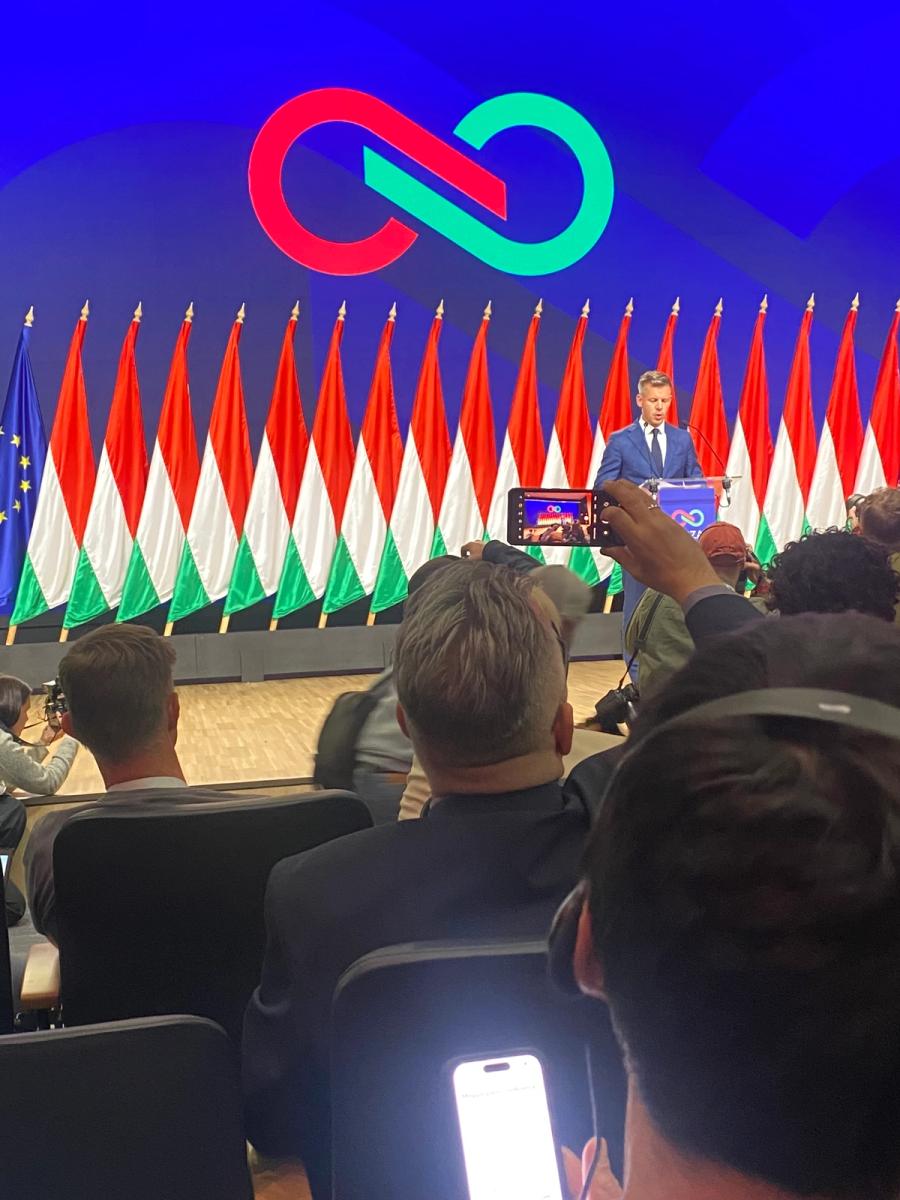

“We did it”, opened Péter Magyar to an endless and elated crowd at Batthyány tér, under the shadow of the Parliament he is set to occupy. The symbolism was sharp. In his infamous victory speech in 2022, Viktor Orbán boasted his win was visible from the moon. On Sunday, Magyar countered “not from the moon, but from every Hungarian window”.
A visibly emotional Orbán delivered a concession speech, in which he recognised the result as “painful”, but congratulated his opponent by phone. This came as a monumental relief to many, as concerns mounted over whether the MAGA-adjacent premier would transfer power swiftly and peacefully – if at all – in case of an election loss.
But he had no other choice. The vote on Sunday was a landslide, representing a historic reversal of power. Magyar’s Tisza party won 53% of the vote, which is projected to translate into 136 seats in the Hungarian parliament of 199 — above the two-thirds magic number required for a constitutional supermajority. Orbán’s Fidesz, sixteen-year incumbents, scraped together just 38% of the vote, resulting in 57 seats.
It was not supposed to go this way. Since their avalanche victory in 2010, which granted them the ability to rewrite the constitution and engineer the electoral system in their favour, Fidesz have retained a two-thirds majority in every election. But despite large-scale vote buying and intimidation, relentless gerrymandering, and feudal-style clientelism corrupting every level of Hungarian society, one point remains crucial: Orbán was governing based on a legitimate popular mandate.
So what went wrong?
What went wrong: Fidesz
In a political lesson as old as time, Fidesz long provided the people ‘bread and circuses’. Their current reign began in 2010 in the wake of the global financial crisis, replacing a government widely viewed as incompetent.
Hungary’s real GDP initially grew slowly but exploded in 2014, consistently breaching an exceptionally high 5% — more than double the average among OECD countries. This growth, spurred by incoming EU funds and an automotive sector boom, translated into real wage gains and life was getting better for millions of Hungarians.
However, when the economy grinded to a halt during Covid, the cracks of the system began to show. Income and living conditions plummeted and never recovered. Hungarians received a second blow when Russia’s invasion of Ukraine sent oil prices soaring; Hungary, remaining dependent on Russian energy, bore the largest cost among EU countries. Year-on-year inflation soaring to 25%, and the central bank raising interest rates to 13% — both records in recent European history.
Orbán also became increasingly belligerent with his European counterparts. The EU soon found itself in a constant stalemate, chained to Hungary and its perennial veto. In response, Brussels froze up to 20 billion euros in funding to Hungary, turning off the tap to a crucial lifeline.
All the while, a problem that had been brewing bubbled to the surface. Hungary’s endemic corruption had long been known about, but was reluctantly tolerated while everyone was doing better. A rising tide lifts all boats, so river fishermen in dinghies could overlook central bank governor Matolcsy’s megayacht.
The Zebra in the Room
But when the bread stopped coming and the only circus left were the Tiborczes and Mészároses of the world, the problem could no longer be swept under the rug. What was initially an operation previously consigned to embezzling funds through inflated state contracts began permeating to every level of society.
“I run an electrical parts company”, tells me Tamás, who gathered his friends and their bets for election night at a pub in central Budapest, “but I cannot compete for a contract because the government has picked the winners, and those winners are their friends”.
The testimony of too many Hungarians — from retiree Magdolna in Hódmezővásárhely, to long-time Fidesz voter Csaba in Szentendre, to UK-based Orbán escapee Lászlo in Budapest — all say the same thing: the corruption has gotten much worse, much more brazen, and has penetrated the street-level.
And after two years of relentless campaigning, Magyar successfully connected the dots, tying the country’s plight to the oligarchy’s plundering; there was no return.
In the recent campaign cycle, while Tisza hammered them on corruption, Fidesz shifted focus to fomenting fear. Allowing Magyar’s salient attacks on the material degradation of Hungary’s infrastructure and public services to go virtually unchallenged, Orbán lambasted Zelenskyy, ringing the alarm bells about a war spillover. From AI-generated videos showing Hungarian men getting executed on a Ukrainian battlefield, to the kompromat operation on Magyar and the alleged staging of a bomb threat on the Serbian border, every attempt the Fidesz campaign made to fight back came off as desperate.
The voters didn’t buy it. The opportunistic Magyar aimed a laser-like focus at tangible issues — the state of the schools and hospitals contrasted with the material wealth hoarded by government-adjacent oligarchs — a tactic which proved particularly prudent while Fidesz focused on an abstract and outlandish Ukrainian threat. “Politics has to be about the people”, declared a triumphant Magyar at his first press conference as prime minister-elect, “and if you consider this populism, then it’s the good kind”.
Tisza’s victory was also a triumph of mobilisation. Captivated by Magyar’s charisma, most minor opposition parties stepped aside and threw their weight behind Magyar. With final election turnout at a record 80%, Tisza’s activation of over 50,000 volunteers ensured the campaign had true grass roots — something missing from previous attempts to mount an opposition. While Magyar visited over 700 settlements, shaking hands to a background of popular music, Fidesz lined sterile conference rooms with rehearsed applause. Magyar’s folksiness made Fidesz seem out-of-touch.
But on election day, it was Fidesz’ own rigged electoral system which sealed its own fate. The mixed vote setup pairs a meticulously gerrymandered electoral geography with a split-ballot vote. With each voter receiving a ballot for local candidate and a national party list respectively, any excess votes not needed to produce a plurality in the former are transferred to the latter. This can have the effect of turning thin margins into sweeping mandates. Although their margins were comfortable, this system of “winner compensation” handed Tisza a seat share much larger than their popular vote would have otherwise achieved.
The Global Implications
On election night, world leaders scurried to call the victorious Magyar to congratulate him — first among whom was Orbán himself. At the morning-after press conference, Magyar thanked the flocks of international journalists in their own language, vowing to ramp up cooperation among the Visegrád countries, work with Giorgia Meloni, and showing appreciation for the Kremlin’s recognition of the election results.
The mention of Donald Trump, however, drew a more reserved reaction. When asked whether he would call the American president, Magyar shrugged off the task as one outside his responsibility.
The election of Magyar might arouse concern for Mr Trump, who wholeheartedly endorsed Orbán, whose successful state capture is seen as a model for modern populists. Nevertheless, when Vice President Vance visited Budapest the week prior, he vowed to work with whoever the eventual winner of the election turned out to be.
This pragmatism was reciprocated by Magyar, who clarified that Hungary’s fate is not determined in Brussels, Washington, Moscow or Beijing — but he is willing to work with each of them in the name of national interest. His pursuit of “energy security” may appease Putin, and Xi Jinping will doubtless appreciate his eagerness to accept capital investments in the form of EV factories.
Europe, perhaps, stands to gain the most from the soon-to-be premier’s foreign policy. If his words translate into deeds, Magyar’s Europhilia may liberate the Union from Hungarian obstructionism, and allow it to operate as a more powerful and unified global player.
His attempt to be universally accommodative of global blocs’ competing interests, however, may ironically prove Hungary to be a tough negotiator — encumbered by the need to maintain a careful balance.
Magyar has made it clear that Hungary and its domestic issues are his foremost concern; it was part of the reason his campaign prevailed over Orbán’s. His Westward orientation will undoubtedly be welcomed by Europe, but with America’s isolationism likely to cause a distancing with Hungary, Moscow and Beijing will keep a close eye on the pragmatic successor of their defeated friend. And no one will be watching more closely than Hungarians, this time from their kitchen windows.