

Early reporting suggests we can expect record turnout.
09:00 AM CET — Record Turnout
Hungarian polling stations have reported unprecedented voter participation numbers by 9 a.m., suggesting experts’ predictions of a record turnout may be proven correct. The National Election Office (NVI) reports 3.46% turnout by 7 a.m., almost double the 1.8% counted at by the same time in 2022. By 9 a.m., this number was at almost 16.89%. Csongrád-Csanád 4 has the highest 9 a.m. turnout so far at 20.22%, and Borsod-Abaúj-Zemplén 3 the lowest at 12.17%, still very high by recent historical standards.
11:00 AM CET — Turnout surge continues
NVI reports countrywide turnout at 37.98% — still a record — with numbers as high as 43.15% in Békés 1 and only as low as 29.33% in Borsod-Abaúj-Zemplén 3. Independent and civil society organisations recommend voters to bring their own pens and use hamisx.com if employers ask you to provide evidence of who you voted for.

13:00 CET — Queues forming
Overall turnout staying strong — 54% nationally by 1 p.m.
A long queue snakes through a primary school, repurposed as Budapest’s District III’s Precincts 35 and 40. Other than a 30 minute wait and a greeting by a stern and stressed election officer, the process is smooth and seemly.
A few blocks down, the District III local government office at Fő tér collects votes brought in from abroad. These votes have two documents enclosed in an envelope: an identity verification, and a ballot enclosed in a further envelope. Apart from allowing its inspectors to identify who cast the vote, this also takes twice the effort to count as a regular ballot.
15:00 CET — Szentendre’s weather vane shifting
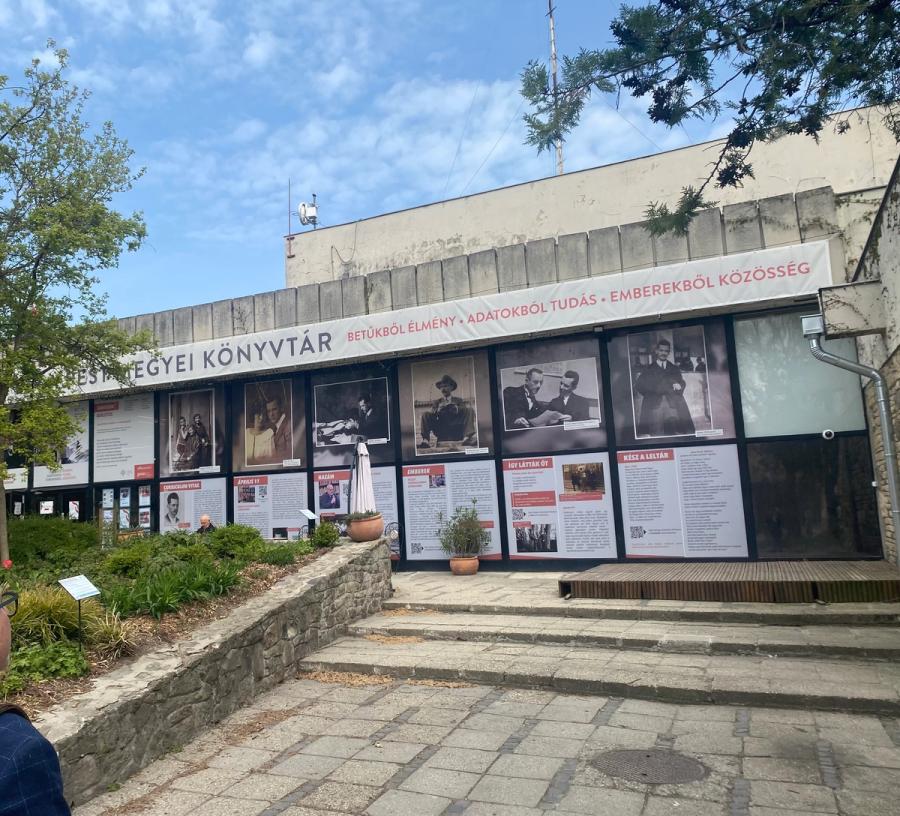
Voters in Szentendre — a wealthy district north of Budapest — are also turning out in record numbers: over 71% by 3 p.m., two young election volunteers tell me. A team of observers from OSCE, walks around the precinct monitoring the process.
The district traditionally goes heavily for Fidesz, but voters I talked to outside Precincts 1 and 2 tell me they are flipping. Both long-time Fidesz voter Csaba, and Dániel, a young teacher who backed Fidesz in local elections, mention the same things: crumbling infrastructure — specifically, the Number 5 Hév railway to Szentendre — and the “unbearable and brazen” corruption.
19:00 CET —Tisza confident
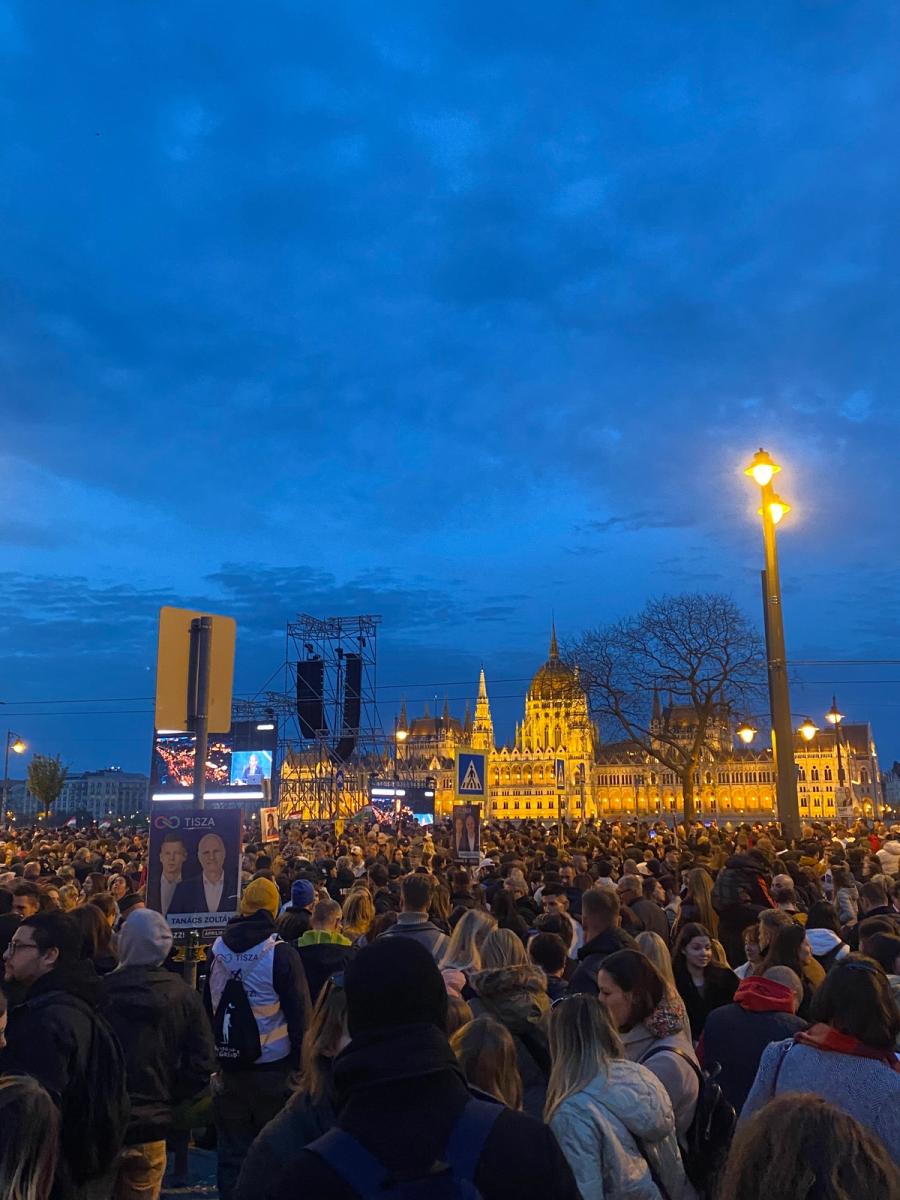
Thousands gather at Batthyány tér, for a Tisza gathering in anticipation of election results. Péter Magyar delivers a confident address, projected on a large screen with the Hungarian parliament in the background. “If the results are the ones we are expecting, we will return to democracy — and we can begin a Hungarian carnival”, announced an optimistic Magyar to a jubilant crowd. Screens plastered around the square display polls showing 54% for Tisza, with Fidesz barely reaching 40%.
20:00 CET — First Results
The first results are displayed on the screen, with 3.3% of list votes counted. Fidesz 53.2%, Tisza 38.7%. Far-right Mi Hazánk has a surprising 6.1%.
20:30 CET — Tisza leading
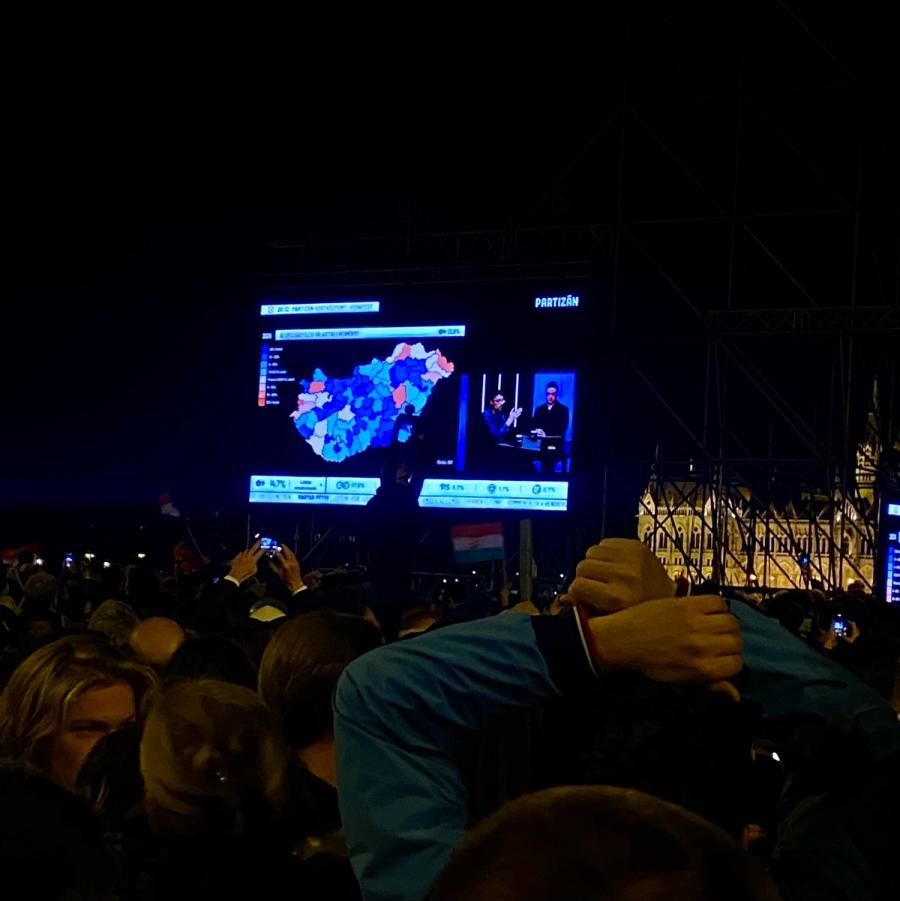
With 14.7% of votes counted, the square erupts as Tisza (47.8%) overtakes Fidesz (43.7%). The electoral map displayed on the screen is overwhelmingly blue.
20:45 CET — Tisza above 50%
With 29.2% of votes counted, Tisza’s share inches forward to 50.3%, to the delight, relief and surprise of a cautious crowd at Batthyány tér. Fidesz At 41%, Mi Hazánk steady at 6.1%.
21:15 CET — Over 50% in
With 53.4% of votes counted, Tisza leads Fidesz 52.5% to 38.8%. A breaking news banner appears — “Orbán congratulates Magyar by phone”. The crowd chants “Orbán go home”. The Partizán broadcast projected on screen announces “Orbán’s sixteen year rule is over”.
22:00 CET — Orbán concedes, Magyar’s victory speech
A visibly emotional Orbán concedes the election, calling it “painful” and urging Fidesz to continue fighting in the opposition. Péter Magyar appears in front of the crowd at Batthyány tér, promising his “Fidesz compatriots [he] will be [their] prime minister too”.
With 97% of the votes counted, Tisza are posed to win 138 of 199 seats — more than the two-thirds needed for a constitutional supermajority. As argued in a previous article, Fidesz’ favourable electoral system backfired on them.